Interval notation
The basics
So, you're solving an inequality. You've found the value(s) of x, but don't know what to do next... This is where the interval notation comes in.
The interval notation is a method of depicting solutions for inequalities. Much like the coordinate plane, the interval notation is a tool for visualising sets of data to the organic eye.
Symbols used
- Circles- ○ and ●
- The open circle (○) is used for strict inequalities (<, >), whereas the closed circle (●) is used for inequalities that aren't strict (≤, ≥). Check the 2nd note for exceptions
- Parentheses and brackets
- When writing the answer, one uses parentheses ( () ) to represent strict inequalities, much like the open circle, and brackets ( [] ) to represent inequalities that aren't strict
- Small lines in areas
- This might be region specific. In the following examples, you're going to see little lines like this \\\\\ within certain ranges. They are used to highlight valid ranges according to which way the greater or lesser than sign points
- + and -
- When encountering quadratic inequalities, you'll see parabolas drawn atop (and below, depending on your preferences) the number line, alongside pluses and minuses. You use them when you have multiple numbers on the number line and when dealing with rational inequalities.
There's multiple ways to approach this, but one of the plausible algorithms for adding the pluses and minuses goes as follows: you select a number from the given range and place it in your equation. If the resulting number is positive, mark the range with a plus, if negative, then minus. Do this for the first 3 (or less ranges), and copy the pattern for the rest of the ranges (as the results will be the same).
As for the ranges that you need to highlight: highlight the plus ranges if your arguments on the left side are supposed to be greater than (or equal to) the right side, negative if lesser than (or equal to) the right side. Afterwards, use those ranges in your answer (shown in example 2)
Examples
Example 1[1]
7x - 6 < x + 12
7x-6-x-12<0
6x-18<0 | :6
x-3<0
x<3
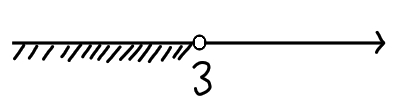
Answer: x ∈ (-∞;3)
Example 2[2]
| (x2+1)(x2-49) | ≧ 0 |
| x2-4 |
Split into parts
| (x2+1)(x2-49) = 0 | |
| x2+1=0 | x2-49=0 |
| x2 = -1 | x2 = 49 |
| x ∈ ∅* | x = ±7 |
*A square cannot be a negative value, therefore the value for that particular x belongs to an empty set
x2-4 ≠ 0
x2 ≠ 4
x ≠ ±2
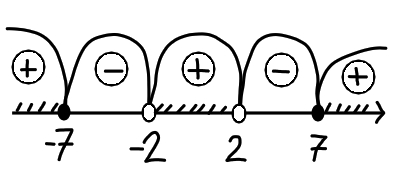
Answer: x ∈ (-∞;-7] ∪ (-2;2) ∪ [7;+∞)
Comments
Tips
As the open circles + parentheses correspond to strict inequalities and closed circles + brackets to non-strict, if you're struggling to remember these sets, you can memorise them via the following silly faces:
- (>○<) for strict inequalities
- [≥●≤] for non-trict inequalities
Notes
- This is merely an insight into the interval notation, not inequalities. I'm not confident on the opening paragraphs, so I anticipate them to be changed first upon unearthing of new knowledge. There's more to know when tackling different types of inequalities- that will (hopefully) be covered in a later entry
- When dealing with rational inequalities, the divisor cannot be 0, so you have to write it down with a "not equal to" sign (≠) and the corresponding circle on the number line will always be open
- Regarding brackets and parnetheses: apparently some people from some regions of the world use them differently when writing answers. This regional difference I lack knowledge on and will not cover
- Regarding the algorithms for determining the range symbols- as mentioned, the algorithm covered in this journal entry is but one of many. Different people will have different explanations for how to determine the polarity... but the end result should be the same, some will just take longer to achieve or be more complicated but briefer than others
Sources
1. Kočektkovs, J., Kočetkova, J. Algebra un elementārās funkcijas. Izdevniecība Zvaigzne; 1972.
2. Daļveida nevienādība. Intervālu metodes algebriskais paņēmiens. EasyMath; 2025. https://youtu.be/eEzB0GbF2Io